
Globeo blog
The Cut-Off Date Killed Your Block: Why Room Blocks Are the Wrong Instrument for Crew Work
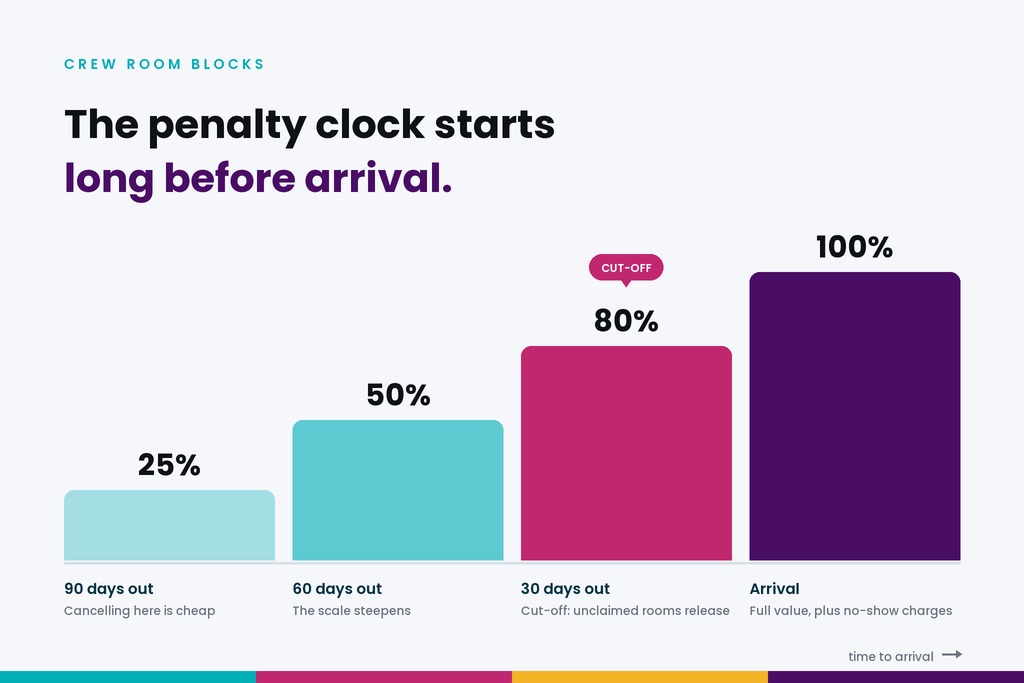
A cut-off date is the day the hotel takes back every room in your block that nobody has claimed yet. Miss it and the rooms go back into general inventory at whatever rate the market will bear that week — which, in a basin during a turnaround, is not your rate. Most crew blocks are not lost to a hotel acting in bad faith. They are lost to a date in paragraph nine that nobody diarised.
The usual response is to treat that as a diary problem: set an earlier reminder, chase the names harder, get the cut-off moved next time. That is worth doing, and it is still treating the symptom. The room block is a conference instrument. It was built for a different kind of trip, and crew work triggers almost every penalty in it by behaving normally.
Below is what each clause actually does, what it costs when the schedule moves, and why the shape of the contract — not the date inside it — is usually the thing that is wrong.
What is a room block, and who was it built for?
A room block is a promise about volume on specific dates. You commit to filling a defined number of room nights; in exchange you get a held rate and held inventory. Every other clause in the contract — cut-off, attrition, cancellation — exists to enforce that promise or to price your failure to keep it.
That bargain works well for a conference. A conference knows its headcount months out, publishes a date that does not move, and can name its attendees weeks before anyone travels. The promise is easy to keep, so the penalties never fire.
Crew work is none of those things. The window shifts, the scope changes mid-job, the headcount is a forecast until the week before, and the names are often unknown until the roster is set. The promise is hard to keep, so the penalties fire routinely — not because anything went wrong, but because the work behaved the way the work behaves.
What is a cut-off date, and why does it land in the wrong place for crews?
The cut-off is the deadline for naming who is in each room. Conference blocks commonly sit at 21 to 30 days before arrival, because a conference knows its attendee list by then.
A turnaround does not. Thirty days out you may know the window and the approximate headcount, and almost never the names. So the block hits its cut-off with half the rooms unnamed, those rooms release, and the crew that was always coming now books into whatever is left at walk-up rates.
Note what has happened there. Nobody cancelled anything. The crew arrived, filled rooms, and paid for them. The block still failed, because it asked a question — who, exactly? — four weeks before the answer existed.
What does an attrition clause actually cost you?
Attrition is the penalty for booking fewer room nights than you committed to. A typical clause sets a performance threshold — 80% is the figure you will see most often — and charges you for the shortfall below it.
Two details decide how expensive that clause becomes:
What the damages are calculated on. Some contracts charge the full room rate on every missed night. Others charge the rate less the hotel's cost of servicing an unoccupied room, or a flat percentage. The difference between those two formulas on a 200-room-night shortfall is not small.
What window it is measured over. A clause that measures each block separately punishes ordinary volatility: the job that finished early pays a penalty even though the job that ran long more than made up for it the following month. Measured per block, a programme that delivers exactly the volume it forecast across a quarter can still owe attrition on half of it.
Neither of those dials makes the underlying commitment go away. They only decide what it costs you when the schedule moves — and the schedule is the one thing on a crew programme that will move.
How does cancellation differ from attrition?
Attrition is booking fewer rooms than promised. Cancellation is walking away from the block entirely, and it is priced on a sliding scale that steepens as arrival approaches. A common shape is a modest percentage of anticipated revenue if you cancel several months out, rising through 50% inside a couple of months, and approaching the full value inside the final weeks.
The number that matters is not the top of the scale. It is where the steps fall relative to how much notice a cancelled project actually gives you. A schedule that steps at 90, 60 and 30 days is priced for a cancellation you see coming a quarter out. Crew mobilisations are cancelled on a fortnight's notice, or less — permits, weather, a client deferring a shutdown by a season. On that timeline you are almost always landing on the expensive end of the scale, whatever the percentages say.
Why can the same empty room be billed twice?
This is the clause that surprises people, and it is worth reading twice in any contract you already hold.
A no-show is an individual reservation that was made and never arrived. It is normally charged one night plus tax. Many contracts then exclude no-shows from your picked-up room nights, on the reasoning that the room was not actually used.
So the same empty room can be billed twice: once as a no-show charge, and again as a shortfall against your attrition threshold. You paid for the night, and the night does not count toward the commitment you paid it against.
Crews are unusually exposed to this. A delayed flight, a shift that runs over, a rotation that swaps at the last minute — these produce no-shows at a rate a conference never sees. A clause that is a rounding error for an annual conference becomes a recurring line item on rotational work.
What a block costs you that a per-night arrangement does not
Put the four together and the pattern is clear enough. Each one is a charge you incur for something that is not a mistake.
The cut-off costs you rooms you were always going to fill. The crew came. The names simply were not ready four weeks out.
Per-block attrition costs you for normal schedule movement. One job runs short, one runs long, and you pay on the short one anyway.
No-show exclusions cost you twice for one empty bed. Once at the desk, once against the threshold.
Rigid name lists cost you at the swap. Where a reservation cannot be renamed, a routine crew change becomes a cancellation and a fresh booking at whatever the rate is that day.
None of those charges exist without a volume commitment. They are not defects in the contract — they are the enforcement mechanism doing exactly what it was designed to do. The question is whether the promise they enforce is one your schedule can honestly make.
What is the alternative to a room block?
A rate arrangement rather than a volume commitment. You fix what a room costs without committing to how many you take. There is no cut-off, no attrition and no cancellation schedule, because there is nothing to release or fall short of. You book the nights you need, you pay for the nights you book, and a schedule change is a booking change rather than a penalty event.
The honest trade is inventory. A block holds rooms; a rate does not. In a market at capacity during a regional shutdown, a rate with no rooms behind it is just a number — which is why the arrangement is only as good as the property relationships standing behind it.
That is the shape of how Globeo prices crew lodging: a negotiated room rate plus one flat per-room-night fee, with nothing recurring and nothing charged for the nights you do not book. In-network properties carry rates that do not fluctuate with the market, and a crew's preferred hotel outside the network is still booked through Globeo with the brand discount applied. There is no block to release, no threshold to perform against, and no scale to fall down.
The failure mode this article is really about is not a missed date. It is signing a conference-shaped contract for work that was never going to behave like a conference, and then absorbing the penalties as a cost of doing business. They are not a cost of doing business. They are the price of using the wrong instrument.
Common questions
Can a cut-off date be extended after it passes? Sometimes, but you are asking for a favour rather than exercising a right, and the answer depends entirely on whether the hotel has resold the rooms. Ask early: a request three days before cut-off is a conversation, a request three days after is an apology.
Is 80% a standard attrition threshold? It is the most common figure, not a rule. Thresholds in the 70s and 90s both appear. The threshold matters far less than how the damages are calculated and what period they are measured over.
Do we owe attrition if the hotel sells the rooms anyway? Many contracts include a mitigation or resale provision reducing what you owe if the hotel resells the released inventory. Where a contract is silent on that, the hotel can be paid twice for the same room — so it is worth knowing which kind you hold.
What is the difference between a block and a negotiated rate? A block holds specific rooms on specific dates and carries attrition and cancellation exposure. A negotiated rate fixes what you pay with no volume commitment and no penalties, but holds no inventory of its own. Getting one of your own has its own threshold — see how many room nights a hotel wants before it will negotiate.
Are room blocks ever right for crew work? Where the dates are genuinely firm, the headcount is genuinely known, and the property is genuinely tight — a fixed-date commissioning window at the only hotel within an hour, say — a block is doing real work. The problem is that most crew programmes sign blocks by default rather than because those three conditions were met.
Who should own the cut-off dates on a block we already hold? Whoever owns the crew schedule, not whoever signed the contract. Cut-off dates are missed when they live in a procurement folder rather than in the same calendar as the mobilisation.
Talk through this in your operation.
A 30-minute demo, a real person from the concierge desk on the call, and the numbers from your last crew rotation.