Globeo blog
How Many Room Nights Before a Hotel Gives You a Corporate Rate?
The figure you will see most often is 250 room nights a year at a single property before a branded hotel will put a negotiated corporate rate in writing. Below about 150 nights a year at that property you are unlikely to get a formal rate from a chain at all, though an independent or a boutique will often open the conversation nearer 50. None of that means a smaller company pays the public rate. It means the discount arrives through a different door.
The number that decides it is not your annual travel budget. It is room nights — one room, one night — at one hotel. That distinction is where most small travel programmes go wrong.
What is a corporate negotiated rate, actually?
What people mean by “corporate rate” is usually a local negotiated rate, or LNR: an agreement with one property, under a code tied to your company, at a price below the public rate for a defined period — normally a calendar year. Two details in it matter more than the headline discount.
Static or dynamic. A static rate is a fixed dollar figure for the year; a dynamic rate is a percentage off whatever the hotel charges that day. Roughly half of corporate travel managers now negotiate dynamic discounts at property level, and for a low-volume account they are the easier ask — they cost the hotel nothing when the market is soft.
Last room availability, or not. An LRA rate must be honoured while the hotel has any room left to sell; a non-LRA rate can be closed out whenever the property expects to do better without you. Almost every rate handed to a small account is non-LRA, which is why the rate that looked good in January is unbookable in the week you needed it.
How many room nights does a hotel want to see?
Nothing here is published, and any hotel will make an exception for business it wants. But the tiers people work to are consistent enough to plan against:
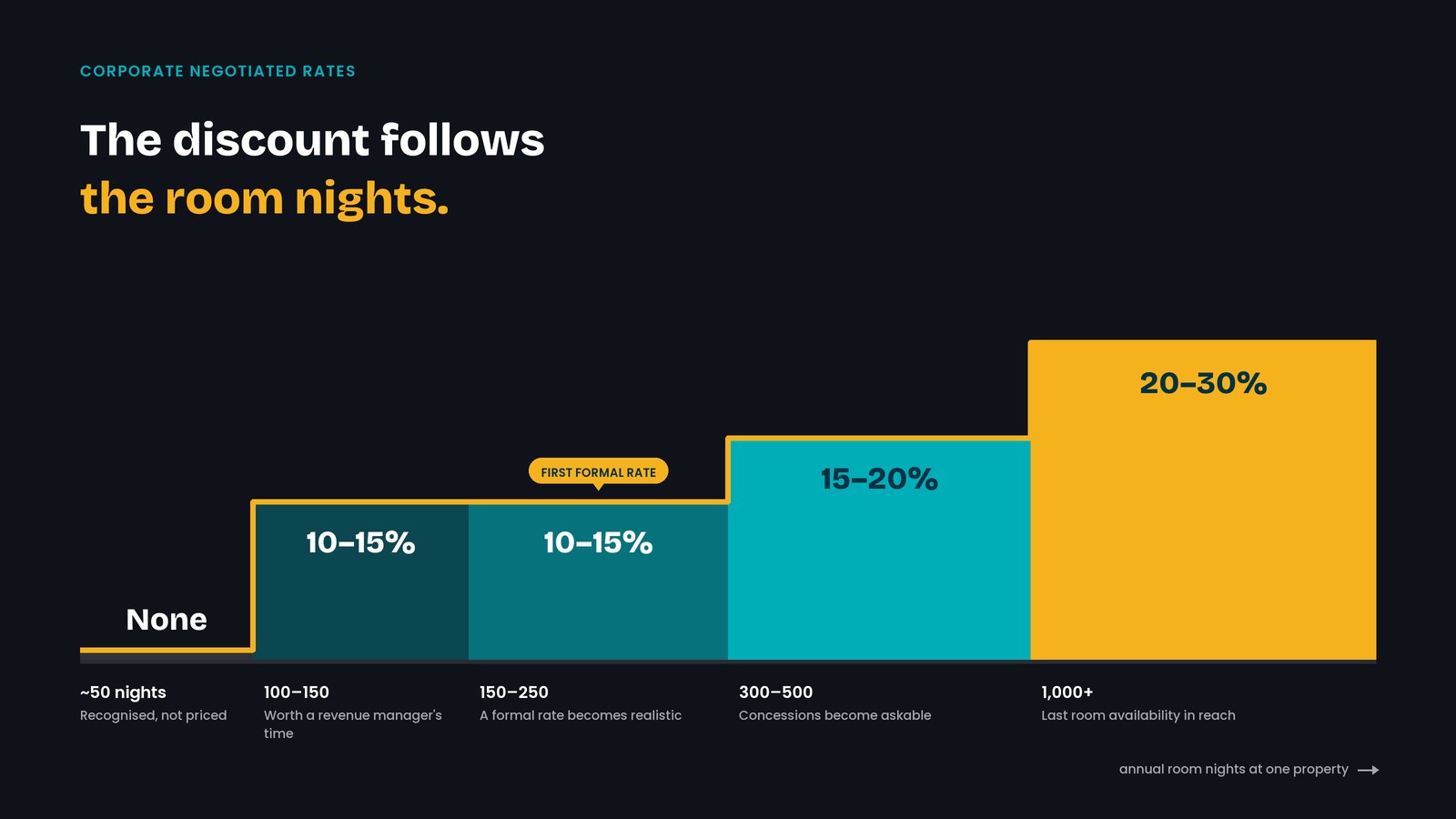
- ~50 nights a year — enough to be recognised at an independent or a boutique; Hyatt Leverage sets its threshold at 50 room nights annually. At a chain property it is usually below the line.
- 100–150 nights — where a volume conversation becomes worth a revenue manager's time. Discounts tend to land in the 10–15% range.
- 150–250 nights — where a formal negotiated rate at a branded property becomes realistic rather than aspirational.
- 300–500 nights — commonly 15–20%, and where you can start asking for concessions that are not price: parking, breakfast, a late checkout standard.
- 1,000+ nights — where 20–30% and last room availability are both realistic asks.
Treat every one of those as a convention rather than a rule. They move with the market, the season, and how badly that hotel needs mid-week business.
Why does the hotel count nights at one property, not your whole spend?
Pure arithmetic. A business spending $250,000 a year on hotels sounds like a serious account. Spread across 40 cities, it is not one account of 1,300 room nights — it is forty accounts of about 30 nights each, every one below every threshold above.
The hotel is not pricing your company. It is pricing displacement risk on its own inventory: how many nights you will deliver to this building, on which days, and what it gives up by holding a rate for you when a citywide event arrives. Thirty nights a year does not move that calculation.
When does the hotel actually decide?
Not continuously. They run on an annual cycle most people outside travel management have never seen:
- June to August — buyers issue their requests for proposal, the majority through Cvent Transient, which carries most corporate RFP volume.
- September to October — hotels accept, decline or counter.
- October to December — accepted rates are loaded into the distribution systems.
- 1 January — rates go live for the year.
Approach a chain property in February and you are asking out of cycle. Note also what the cycle asks of you: commit, in August, to where your people will sleep for the next twelve months.
One exception. A property-level LNR can be agreed directly with a hotel's director of sales at any time of year, no platform required. For a company doing 60 nights at one hotel, that email is the entire strategy.
What can a company under the threshold get?
Quite a lot, and none of it requires a volume commitment:
Brand small-business programmes. Every major group now runs one, and their defining feature is that the threshold is gone. Hilton for Business advertises up to 20% off with no minimum spend to join or stay enrolled; IHG Business Edge carries no enrolment fee and no minimum across more than 7,000 hotels; Business Access by Marriott Bonvoy covers hotels alongside flights and cars. For a company doing 200 nights across 30 cities they will usually beat anything you could negotiate yourself.
Aggregated volume. A travel management company pools its clients' nights, which is how a 40-night company reaches pricing built on a million. The same principle applied to lodging is how Globeo prices crew lodging: a negotiated room rate plus one flat per-room-night fee, nothing recurring, nothing charged for nights you do not book. In-network properties carry rates that do not move with the market, and a crew's preferred hotel outside the network is still booked with the brand discount applied. There is no RFP to run and no volume to promise in order to qualify.
Why does none of this fit project work?
Everything above assumes a stable pattern — the same cities, the same properties, roughly the same nights, year after year. That is what the RFP calendar is built on, and it is what project work does not have. A contractor bidding work does not know in August which counties will be active in March. A storm restoration sends a hundred people somewhere nobody had a rate for and nobody could have had one. By the time you have accumulated 250 nights at a property, the job that put you there has finished, and the rate is a discount in a town you have left.
That is a structural problem, not a negotiating one, and it is why project-based operators pay walk-up rates in exactly the weeks walk-up rates are worst — a basin during a turnaround, a coastal county after landfall — while holding a folder of rates for cities they are not in. It is the same mismatch that makes a room block the wrong instrument for crew work: a contract shaped for predictable demand, signed by an operation that has none. Borrowing somebody else's volume is not a workaround there. It is the correct instrument.
What should you do about it this week?
Count nights per property, not spend per year. Pull twelve months of folios and sort by hotel. You are looking for anything above about 50.
Email the director of sales at whatever tops that list — not the front desk, not central reservations. Name the nights you did there last year; it is the only fact in the email that matters. Ask for a percentage rather than a price unless your volume is well into the hundreds. Then enrol in the brand programmes for everything else: free, no minimum, and they cover the long tail of cities where you will never have a position. If your crews move between project sites rather than between offices, that long tail is most of your programme.
Then test the rate before you rely on it. Book a real date and check the discount appears. A rate that is signed but not loaded, or loaded non-LRA and closed out, behaves exactly like no rate at all — and you find out on the night the crew arrives.
A rate is only half the arrangement. Whether that hotel will invoice your company at all is a separate credit decision on its own timeline — see what a hotel requires before it will bill you directly. And once a number is agreed, it is worth knowing what that rate actually includes, because it is the room and very little else.
Common questions
Can a small business get a corporate hotel rate at all? Yes, but usually not the kind that comes out of an RFP. The realistic routes are a brand programme with no minimum spend, a direct arrangement with one property where you already have volume, or a managed programme that aggregates other companies' nights alongside yours.
Is a negotiated rate always cheaper than booking online? No. A static rate agreed in October can sit above the public rate during a soft week, and frequently does — the strongest argument for a percentage-off-public-rate structure, which cannot lose that comparison by definition.
What if we do not hit the volume we said we would? Generally nothing immediate — unlike a room block there is no attrition charge, because you never committed to a quantity. It shows up at renewal: hotels review actualised room nights, and an account that produced a fraction of its forecast is re-priced or declined. Under-production is the most common reason a rate is not renewed.
How long does it take to get a rate in place? A brand programme is same-day. A direct LNR with one property is days to a few weeks. A full RFP cycle is months, and only produces rates starting 1 January.
Talk through this in your operation.
A 30-minute demo, a real person from the concierge desk on the call, and the numbers from your last crew rotation.