
Globeo blog
Which Hotels Will Bill Your Company Directly for Crew Lodging?
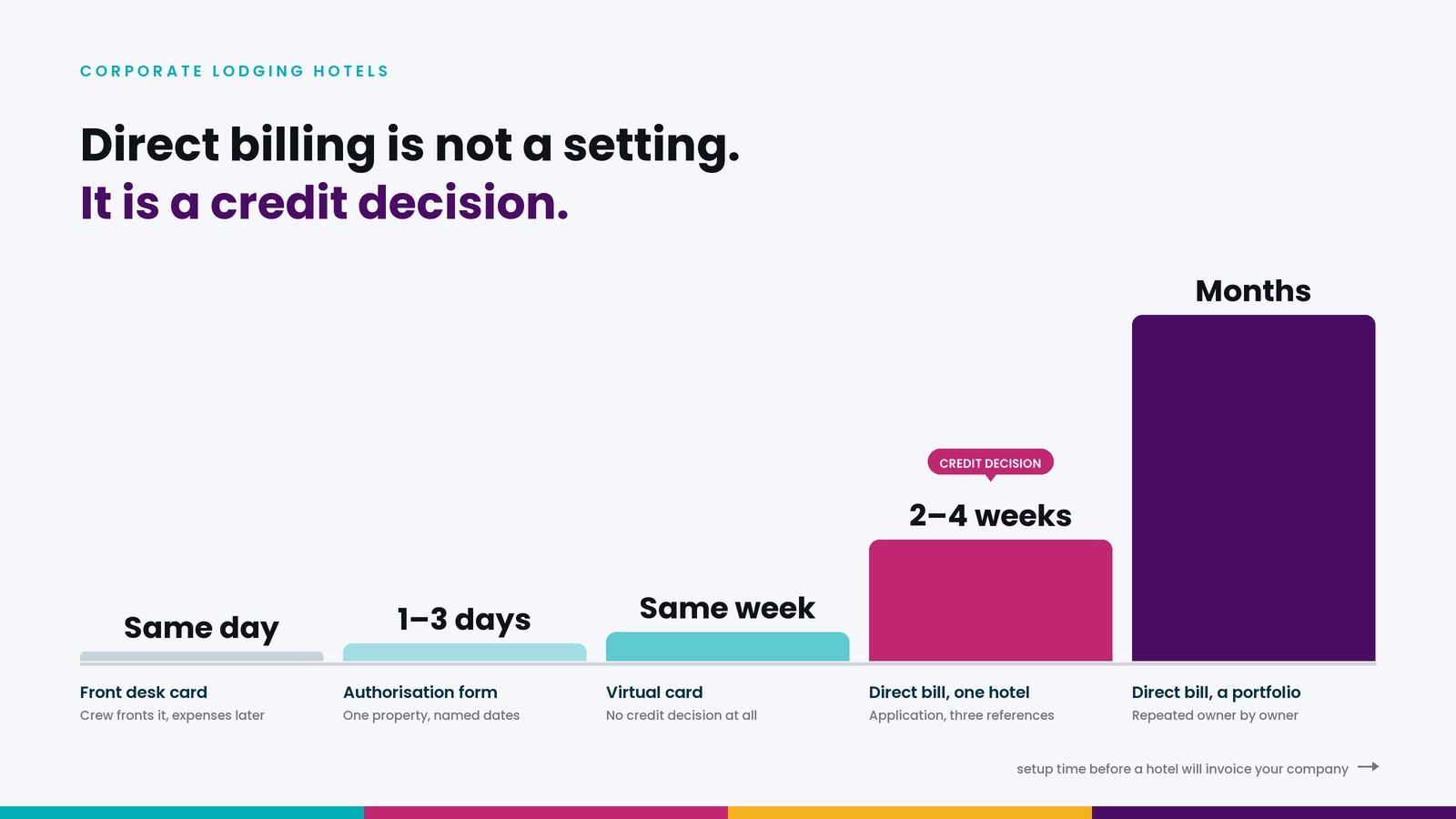
Any hotel can bill your company directly, and almost none will do it on the first booking. Direct bill is a credit decision rather than a booking option: the property runs your company through an application, and the figure you will see most often is two to four weeks before the account is open. It is also granted property by property rather than by the brand on the sign, so an approved account at one hotel does not follow your crew to the next one.
That second part is what catches project-based operators. The stay you need billed is at a property you have never used, in a county you were not working in last month, starting Monday.
What does direct billing at a hotel actually mean?
Direct bill means the property extends your company trade credit. The crew checks out without paying, the hotel sends an invoice, and you pay on terms — net 30 is the usual default, with net 15 turning up at independents and at properties that have been burned before.
What it is not is a setting. There is no box to tick during booking. The account has to exist before the reservation does, and the reservation has to be routed to it — an instruction attached to the booking, not something a front desk agent can improvise at 11pm when twelve people walk in off a fourteen-hour day.
What does a hotel require before it will invoice a company?
The form is short. The list behind it is consistent enough to prepare once and reuse:
- a completed credit application on the property's own form
- three trade references — the number most applications ask for
- a bank reference or bank letter
- a W-9 and your EIN
- an estimate of annual room nights at that property
- a signed terms page, usually net 30
Then the wait. Two to four weeks is what gets quoted most often, and a full 30 days is normal where accounts receivable sits with a management company rather than at the hotel. The room-night estimate carries more weight than people expect: a property weighing the administrative cost of carrying an account against fifteen nights a year will usually decline, and it will usually decline by not replying.
Does direct bill approval carry across a hotel brand?
Usually not, and this is the most expensive assumption in crew lodging. The large majority of branded hotels in the United States are franchised — owned and operated by a company that is not the brand on the sign. Accounts receivable lives with that owner, so credit is extended by the owner, to your company, for that hotel.
Approval at one property is therefore not approval at the same-brand property forty miles up the highway if a different ownership group holds it. Nobody tells you this. The crew finds out at the desk, and somebody puts eleven rooms on a personal card.
The exception is worth chasing: where one owner or management company runs several properties, a single application often covers the whole portfolio. Ask who holds accounts receivable before you ask for the form — it is the cheapest multiplier in this process and it takes one phone call.
What can you use while approval is pending?
Two instruments, solving two different problems.
A credit card authorisation form. Same day to 48 hours, signed by the cardholder and emailed to the property. It names the cardholder, the guests, the dates, and — the reason the document exists — exactly what it covers: room and tax only, or room, tax and incidentals. It is valid for that stay at that property and nothing else.
A virtual card. A single-use number issued per reservation, capped at the expected total and valid only for the date range. It sidesteps the credit decision completely, because the hotel is simply taking a card. Two failure modes to plan around: the cap is fixed, so a folio that grew a parking charge or a late checkout can fail at settlement, and a small number of properties still will not key a number they cannot swipe.
Neither is a lesser version of direct bill. For crews moving between sites they will never see again, a virtual card is the better instrument outright.
Why is the crew still being asked for a card at check-in?
Because room and tax went to the master account and incidentals did not, and the front desk has to secure something.
The hold is where the damage happens. The range you will see most often is $50 to $100 per room per night, sometimes a flat $100 to $250 for the stay, released 5 to 10 business days after checkout. On a credit card that is an irritation. On a debit card — which is what a great many crew members carry — it is a week's money gone on a trip the company is paying for, and it is the complaint that reaches a supervisor first.
Fix it on the reservation, not at the desk. The split has to be instructed up front: room and tax to the master account, incidentals to the guest, or everything to the master under a stated cap. A split that was never instructed cannot be reconstructed after checkout, because the charges have already posted to the wrong folio. What arrives then is an invoice you dispute line by line, three weeks after the crew went home — which is the reconciliation work consolidated invoicing exists to remove.
Does a tax exemption certificate work on a direct-billed stay?
Sometimes, and the rules are set by each state rather than federally. Several states exempt only direct government employees paying with a government-issued card, not a contractor paying with a corporate card, even under a federal contract. Where an exemption does apply it generally has to be presented at check-in, on that state's own certificate, with the stay billed to the exempt entity — not claimed afterwards against an invoice that already carries the tax. Lodging tax commonly lands around 12–17% of the room rate once state, county and city portions are stacked, so if you work under government contracts, confirm the position state by state rather than assuming the certificate travels.
What should you do about it this week?
Pull last quarter's folios and count properties, not nights. Most operators are surprised by how few they return to and how many they used exactly once.
For the three or four you do return to, call the director of sales and ask two questions: who holds accounts receivable, and does one application cover the group. For everything else, stop applying — standardise on a virtual card or an authorisation form, and write the folio-split instruction into your booking template rather than remembering it per booking. It is the instruction most often forgotten, and the only one whose absence lands on a crew member's own account.
Then ask the crew whether anyone was asked for a card. That is the only honest measure of whether billing worked, and it is in no report.
Below a handful of repeat properties the arithmetic does not favour applications at all, and an account that already exists is the faster instrument. That is what a managed programme is: across 30,000+ partnered hotels the account, the credit and the folio instructions are already in place, so the crew checks in without producing a card and the month arrives as one cost-coded invoice instead of forty folios from six properties. It is the same reason a negotiated rate is hard to earn on project work: both instruments reward returning to the same place, and crews do not.
Common questions
How long does hotel direct bill approval take? Two to four weeks is the figure quoted most often, and a full 30 days where accounts receivable sits with a management company rather than at the property. An application submitted for a job starting Monday will not be approved in time, and no amount of urgency moves a credit department.
Can a small company get direct billing at a hotel? Yes. Volume at that property decides it far more than company size does. A hotel seeing 150 nights a year from you will open an account it would not open for fifteen, and a single-property independent will often say yes where a branded hotel would not.
Is a credit card authorisation form the same as direct billing? No. An authorisation form charges a card you already hold, for named guests on named dates at one property, and it expires with the stay. Direct bill is an open account with payment terms and no card involved.
Why did the hotel charge our crew's personal cards when we had direct bill? Almost always a folio split that was never instructed. The master account covered room and tax, incidentals were left with the guest, and the front desk secured them against whatever card the guest handed over.
Do we still need direct bill if we use virtual cards? Often not. A virtual card settles payment and reconciliation without any credit decision, which is most of what direct bill was for. What it does not cover is a folio that exceeded its cap.
Talk through this in your operation.
A 30-minute demo, a real person from the concierge desk on the call, and the numbers from your last crew rotation.