
Globeo blog
What Does a Corporate Negotiated Rate Actually Include?
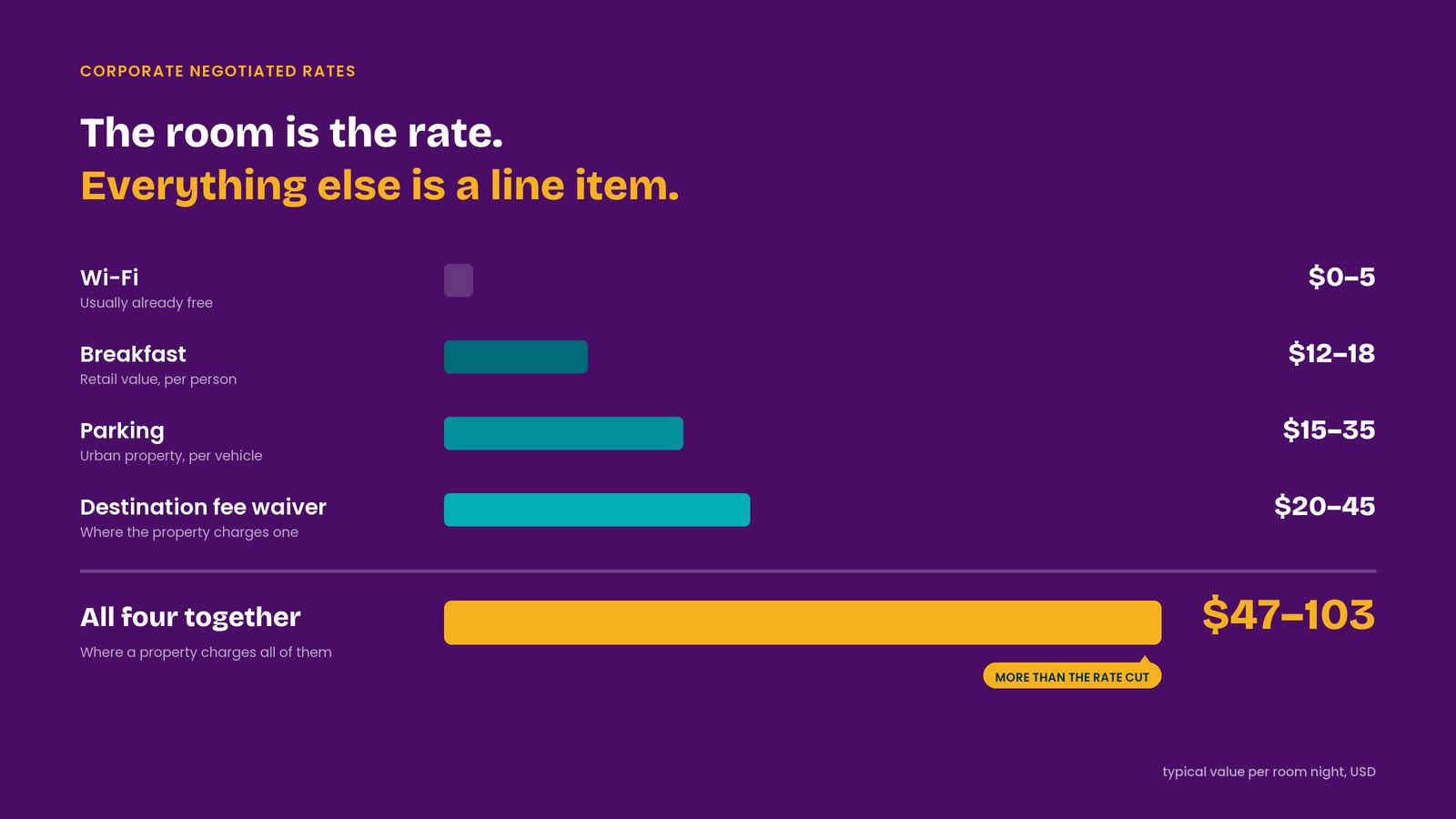
A corporate negotiated rate covers the room and nothing else. Wi-Fi is usually already free, taxes sit on top, and breakfast, parking and every other amenity are separate charges unless someone wrote them into the rate agreement. The inclusions people assume arrive with a corporate rate are not automatic — each is individually negotiated, and most are easier to win than a lower nightly number.
That last part is the useful bit. A property that has stopped moving on price will usually keep moving on everything around it — and on a crew stay those things are often worth more than the discount being argued over.
What comes with a corporate negotiated rate by default?
Very little. A local negotiated rate — the LNR, which is what most people mean by “corporate rate” — is a room-only price for a defined period, normally a calendar year. You get the room, in the room type named in the agreement, plus the basic Wi-Fi every major brand now includes anyway. Treat that Wi-Fi as a floor, not a concession.
Everything else is its own line on the folio and its own negotiation: breakfast, parking, laundry, housekeeping frequency, early check-in, a waived destination fee. Room type counts too — a rate sheet reading “standard king” does not cover a two-person crew needing a double queen.
Taxes never become an inclusion. Occupancy and lodging tax in the United States commonly lands between 10% and 18% depending on the city, and it is calculated on the rate you negotiated, so a lower rate pulls the tax down with it. That is the one structural advantage a rate cut holds over an amenity.
Why will a hotel add breakfast before it lowers the rate?
Because the two cost the property very different amounts, and only one lands in the report the revenue manager is measured on.
Cutting a $150 rate by $10 costs the hotel $10 of average daily rate — ADR — on every night you book. ADR feeds the property’s performance review, its standing against its competitive set, and next year’s opening position. Once a rate comes down it is hard to pull back up.
Breakfast costs the hotel its food cost, not the menu price. The figure you will see most often is a cost of goods around a third of counter price — so a $15 breakfast might cost the property $5, arrive with a headline value three times that, and touch ADR not at all.
So when a property says it has reached its floor on rate, that is often true — and the conversation is not over. Ask what can be added instead.
Which inclusions are worth asking for on a crew stay?
This is where crew lodging parts company with ordinary business travel. A crew keeps different hours, arrives in different vehicles and stays longer, so half the standard inclusion list is irrelevant and the items that matter are missing.
Breakfast, but only if the timing moves. A hot breakfast from 6:30am is worth nothing to a crew that rolls out at 4:30. The ask is grab-and-go bags set out the night before, or a hot service starting at 5. Properties that host crews already do this; those that never have will often agree, but only if it is raised during the rate conversation, not at the front desk on night one.
Parking that fits the vehicles. A crew cab and a trailer is not a parking space — it is two or three, or a corner of the lot, and a downtown property with a parking structure may not be able to take it at all. Where parking is charged, the figure you will see most often at an urban property is $15–35 per vehicle per night, which across a six-truck crew outweighs the rate difference just negotiated. Get vehicle count and dimensions in before the rate is agreed.
Laundry, on anything longer than a week. On a 14- or 21-day rotation, on-site guest laundry is the reason nobody needs a mid-rotation trip into town. It costs the property close to nothing and it is rarely asked for.
Early check-in, which matters more than late checkout. Night-shift crews arrive at 7am wanting a bed, and 7am belongs to the previous night as far as inventory is concerned. Properties often price it as a partial or full extra night, because holding the room genuinely costs them one. It is the hardest item here, and the one most likely to be paid for rather than included.
The destination fee, where one is charged. Resort and destination fees commonly run $20–45 a night for amenities a working crew will never use. Waiving them for a negotiated account is routine, and worth more per night than most rate concessions.
One caveat. If a crew already draws a meal per diem, an included breakfast does not cut what the company pays — the allowance goes out either way. It cuts what the crew spends at 5am, which is a retention argument rather than a savings one.
What is never included, however hard you negotiate?
Taxes. Occupancy, lodging, state and city taxes are statutory. No property can waive them, and a rate quoted as “inclusive” only means somebody did the arithmetic for you.
Incidentals and damage. A negotiated rate changes neither the hold placed at check-in nor liability for a damaged room. Those follow from how the folio is routed, which is a separate arrangement from the rate — see what a hotel requires before it will bill your company directly.
Availability. The most expensive misunderstanding in this subject is that a negotiated rate guarantees a room. It does not. A rate carrying last room availability must be honoured while the property has anything left to sell; a rate without it can be closed out on any date the hotel expects to do better without you. Almost every rate handed to a smaller account is the second kind, and that one clause is worth more than every amenity on this page combined — see how many room nights a hotel wants before it negotiates.
How do agreed inclusions get honoured at the front desk?
By being attached to the rate code, not by existing in an email.
A negotiated rate exists at booking time only once it has been loaded — entered against your company’s code in the property’s system and the channels you book through. An inclusion behaves the same way. Breakfast agreed in a negotiation and never loaded is breakfast the night auditor charges for, and the crew member at the desk at 5am cannot prove otherwise.
So put every inclusion in the rate agreement itself, alongside the price, rather than settling it verbally with a sales manager who may not be there in March. Sales negotiates and the front desk executes; the only thing connecting them is what is in the system. Then read the first folio — the cheapest moment there will ever be to catch a missing inclusion.
Timing matters too. Rates for the following calendar year are typically negotiated across the middle and back half of the year and loaded to take effect on 1 January, so asking in February means asking a property to reopen an agreement it has already loaded.
To start this week, pull three months of folios for your highest-volume property and add up everything that is not the room. That total is what you are really negotiating over, and it is routinely larger than the rate gap getting all the attention. Where crews rotate through the same basin for months at a time, have that conversation with every property on the rotation.
Common questions
Does a corporate negotiated rate include breakfast? Not unless it was written into the agreement. Some brands bundle breakfast into the room product at every property, which is a different thing — that is the brand’s standard rather than your negotiated inclusion, and it can change without reference to your rate.
Is it better to negotiate a lower rate or more inclusions? Below a property’s rate floor, inclusions. They cost the hotel a fraction of their face value and do not touch ADR, so a property will give more of them. The exception is tax, which only a lower rate reduces.
Can a hotel remove an inclusion partway through the year? It should not, where the inclusion is named in the rate agreement for a defined term. In practice inclusions go missing because they were never loaded against the rate code — a loading failure rather than a contractual one, caught by reading the first folio.
Do inclusions apply to every room type in the agreement? Only where the agreement says so. Inclusions are commonly attached to a named rate code, so a booking that lands on a different room type or a different code can arrive without them. This is the most common way an agreed amenity quietly disappears.
Talk through this in your operation.
A 30-minute demo, a real person from the concierge desk on the call, and the numbers from your last crew rotation.