
Globeo blog
What Is the GSA Lodging Rate, and Can Contractor Crews Use It?
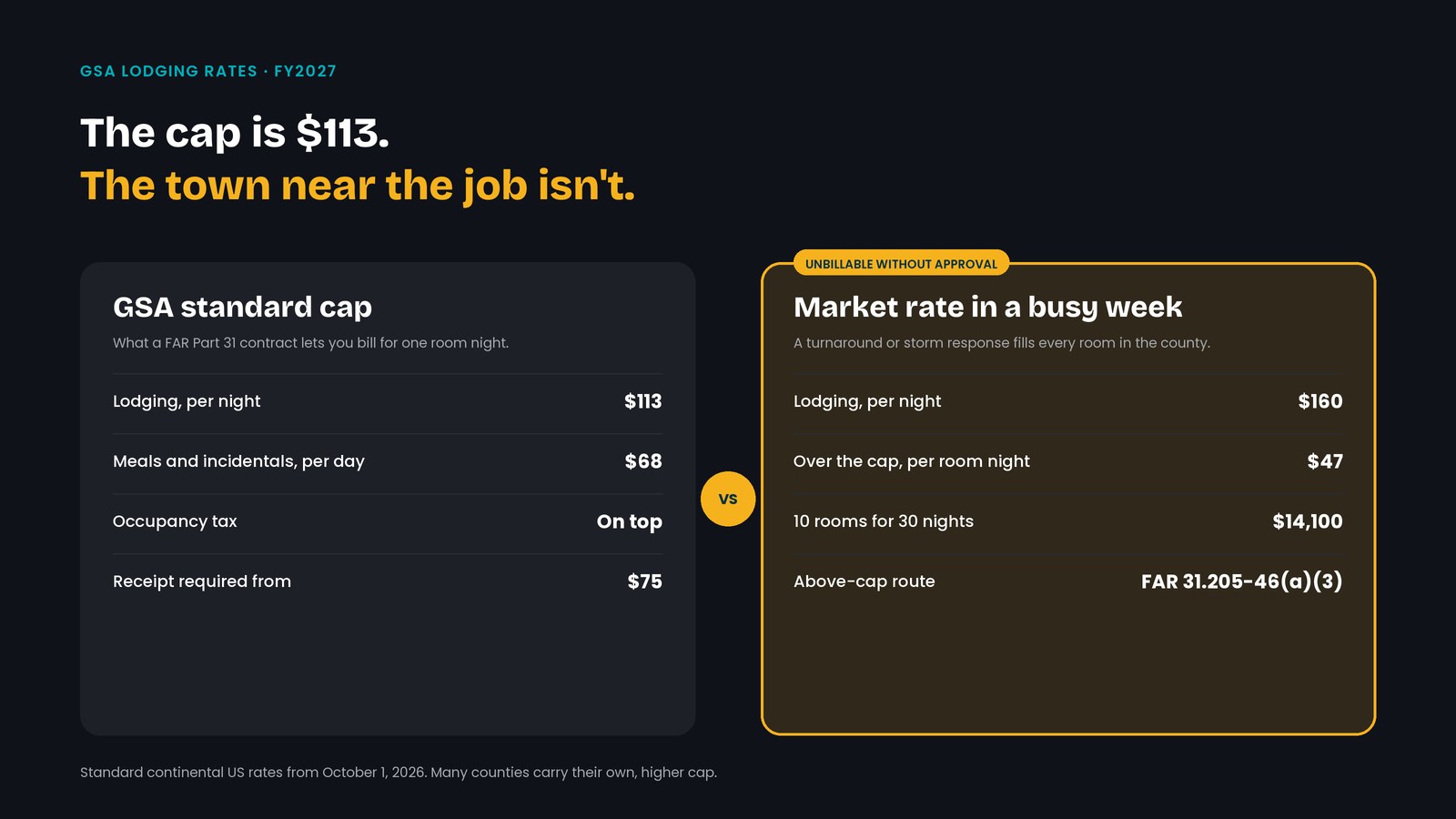
The GSA lodging rate is the most the federal government will pay for one night in a hotel in a given place: $113 across most of the continental US for fiscal year 2027, which began on October 1, 2026, and more in roughly 300 named cities and counties. A contractor crew cannot claim it at the front desk as a right, but on cost-reimbursable work the same number usually caps what the contractor can bill for the room. That gap, a ceiling that binds you and a discount that may not be offered to you, is where most contractor lodging budgets go wrong.
What is the GSA lodging rate for fiscal year 2027?
The General Services Administration publishes per diem rates once a year for the federal fiscal year, which runs October 1 to September 30. The FY2027 bulletin, FTR 27-01, raised the standard continental US lodging rate by $3, from $110 to $113 a night. The meals and incidentals rate stayed at $68 a day, so the standard combined figure is $181. On the first and last day of travel, meals and incidentals are paid at 75%, which is $51 at the standard rate.
Two details catch people out. Around 300 localities carry their own rate, set county by county, and some are seasonal: a coastal county can carry one cap in July and a lower one in January. And the lodging figure is a ceiling, not an allowance: the traveller is reimbursed what the room cost, up to the cap. Check the county on GSA's per diem lookup before you quote a job.
Do GSA rates apply to government contractors?
Not directly. The Federal Travel Regulation governs federal employees. But the Federal Acquisition Regulation borrows it. Under FAR 31.205-46, on contracts where costs are judged by FAR Part 31, which in practice means cost-reimbursement and time-and-materials work, lodging, meals and incidentals are reasonable and allowable only to the extent they do not exceed, on a daily basis, the maximum per diem rates in effect at the time of travel. That means the FTR rates in the continental US, the Joint Travel Regulation for Alaska, Hawaii and US territories, and State Department rates abroad.
The same clause requires a receipt for every expenditure of $75 or more. With a $113 cap, that is every hotel night your crew spends.
On firm-fixed-price work the cap does not police each folio, but the bid usually priced lodging at the GSA rate, so every night above it comes out of margin. Many primes also flow the cap down to subcontractors as policy. Which rules bind you depends on your contract's clauses, so read those first.
Will a hotel give a contractor crew the government rate?
Sometimes, property by property, and rarely on the strength of a company name. A hotel's government rate is generally set up for federal travellers on official orders, who show government ID at check-in. Some properties extend it to contractors who bring a letter from the contracting agency or a copy of the contract; many do not, and almost none do when the town is full.
Even then, the pattern you will see most often is a hotel loading its government rate at or just under the local per diem and then limiting how many rooms it sells at that price each night. Ask for twelve rooms in a busy week and the government rate may cover two or three of them, or none. Plan to the cap, not to the discount: the GSA number tells you the most you can recover, not the price you will be offered.
What happens when hotels near the job site cost more than the GSA rate?
This is the common case. A county sits on the $113 standard rate because rooms there are usually cheap. Then a plant turnaround or a storm response arrives, every crew in the region wants rooms at once, and the market rate near the site goes to $160. The per diem table does not move mid-year to follow it. There are three ways out, and each has a cost.
Stay further out. A town 40 minutes away may still be at the cap. But drive time comes off a 12-hour shift twice a day; see how far from the rig oilfield crews should stay.
Use the actual-expense exception. FAR 31.205-46(a)(3) allows costs above the per diem maximum in special or unusual situations, up to the higher amounts the FTR authorises for federal civilian employees, which under the FTR's actual-expense method reaches up to 300% of the applicable maximum. It comes with three conditions: a situation that would justify actual expense under the FTR must exist; an officer of the contractor, or a designee, must approve a written justification; and if you use it repeatedly or continuously in the same area, you need the contracting officer's approval in advance. Get that approval before the crew's second week, not when the invoice is already disputed.
Absorb the difference. Ten rooms at $160 against a $113 cap is $47 a room a night, which is $14,100 over a 30-night month that you cannot bill. That figure is the number to put in front of whoever is deciding between the first two options.
Are taxes included in the GSA lodging rate?
No. The GSA lodging rate excludes taxes. Federal travellers claim lodging taxes separately, as a miscellaneous travel expense, and contractors generally follow the same convention. So a $113 room in a market with a 15% combined occupancy tax actually costs about $130 once the folio is printed, and both lines need to be shown separately on the receipt.
Do not count on the federal tax exemption: where states exempt government lodging, it usually reaches stays the government pays directly, not a contractor's. Length of stay is the more reliable lever, because many states stop charging occupancy tax after a set run of consecutive nights. Texas, for example, exempts stays of 30 consecutive days or more, with its own rules on how the exemption is claimed. We go further into exemption handling in our guide to government contractor crew lodging. Confirm the rules for your state with your own tax advisor.
How do you keep a crew booking inside the GSA cap?
Most lodging overruns are decided before anyone checks in, so the work is front-loaded.
- Look up the cap for where the crew sleeps, not where it works. The rate follows the location of the lodging. A hotel across a county line can sit under a different cap from the job site.
- Check the month. A crew that mobilises in September and stays into October crosses a fiscal-year change, and in a seasonal locality possibly a seasonal one too.
- Give the cap to whoever books, as a nightly ceiling, before they search. A room that comes back at $119 has to be rebooked; one searched against $113 from the start does not.
- Keep the record per person, per night. Globeo puts every room night on one invoice with its cost code attached at booking, and Stay History reports export it line by line, so the receipt trail exists without rebuilding it from folios.
- Get actual-expense approval in writing before you mobilise into a market you already know is over the cap.
One line Globeo does not cross: it books and bills rooms. Meals and incidentals, and any per diem your crew is paid, stay with your own payroll and travel policy. For teams on public work, our government crew lodging page covers how bookings are coded and invoiced, and you can book a demo to see it on your own contract.
Common questions
What is the GSA lodging rate for 2027? $113 a night across most of the continental US, up from $110, with meals and incidentals unchanged at $68 a day, from October 1, 2026 to September 30, 2027. Around 300 localities carry their own, higher rate.
Can a government contractor get the GSA government rate at a hotel? Only if the hotel chooses to offer it, usually against a letter or a copy of the contract. Expect it to cover a few rooms a night at most, and none when the market is busy.
Can a contractor bill lodging above the GSA rate? On FAR Part 31 contracts, yes, in special or unusual situations under FAR 31.205-46(a)(3), with a written justification approved by a contractor officer and advance contracting officer approval for repeated use in the same area.
Does the GSA lodging rate include taxes? No. Taxes are claimed separately, so a room at the cap costs more than the cap once tax is added. Many states exempt long stays, such as 30 consecutive days or more in Texas.
Do contractors need hotel receipts for GSA-capped lodging? Yes. FAR 31.205-46 requires a receipt for each expenditure of $75 or more, which covers effectively every hotel night at a $113 cap.
Talk through this in your operation.
A 30-minute demo, a real person from the concierge desk on the call, and the numbers from your last crew rotation.