
Globeo blog
How Far From the Rig Should Oilfield Crew Lodging Be?
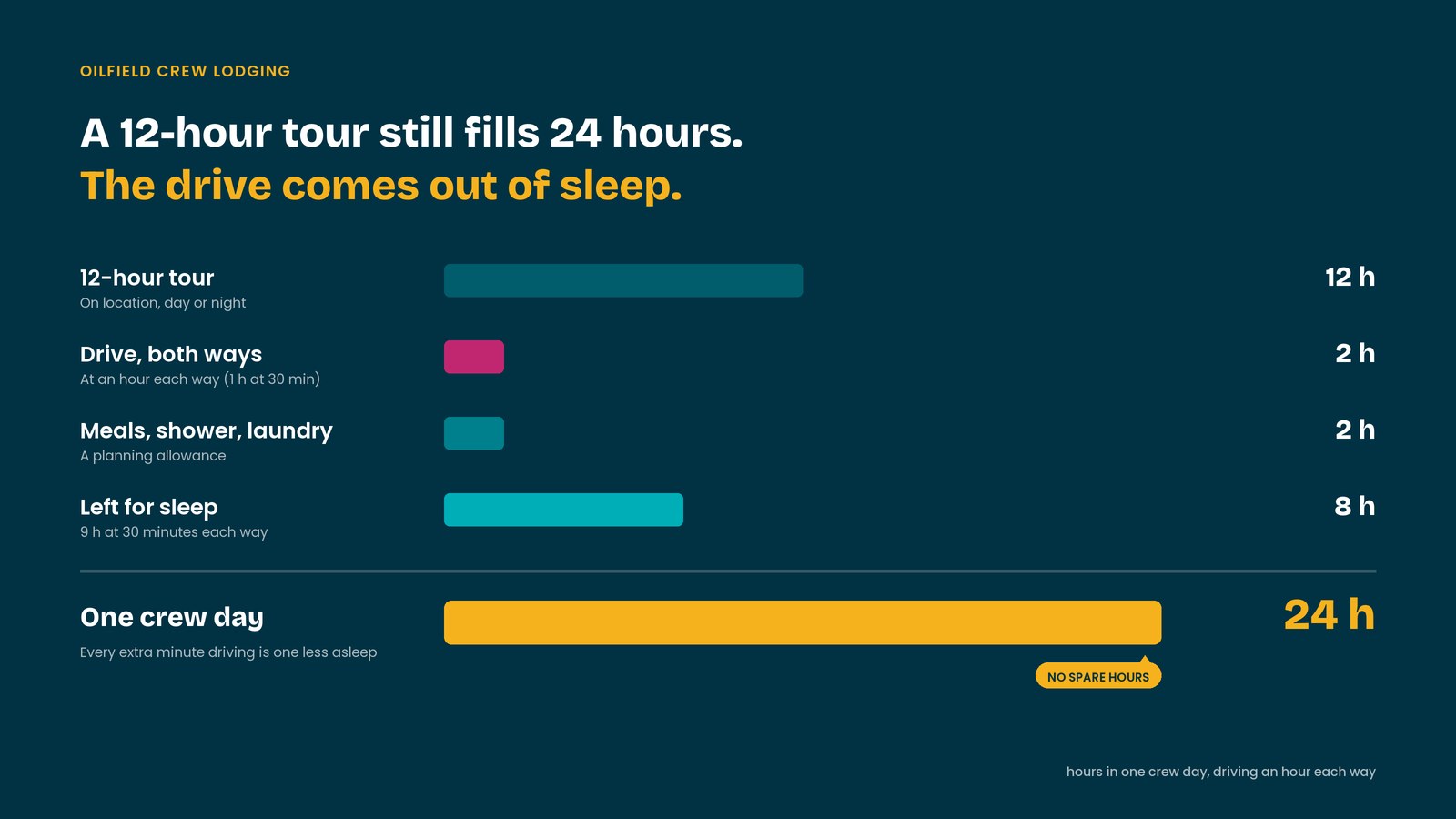
Close enough that the drive is 30–45 minutes each way at shift change, with an hour each way as the ceiling — measured in drive time, not miles. No regulation or industry standard sets a maximum commute distance; the limit comes from the hours. A 12-hour tour leaves 12 hours for the drive, meals and sleep, and past about an hour each way the drive starts coming out of sleep.
Why measure distance to the rig in drive time instead of miles?
Because the miles that matter are the slow ones. The last part of the route is lease roads and caliche, two-lane highway shared with sand and water haulers, and a check-in at the location gate. Map apps overestimate speed on exactly those stretches.
Towns add their own delay. In 2019 TxDOT found that getting through Pecos on US 285 could take up to 20 minutes at peak hour, with trucks making up 20–40% of traffic in the study area. A hotel past a choke point like that can be farther in practice than one with more miles on the odometer.
How much sleep is left after a 12-hour tour and the drive?
Drilling crews typically work 12-hour tours, day and night, which leaves 12 hours off. NIOSH advises oil and gas employers to leave enough of that for the commute, meals and 7–9 hours of sleep. Allow about two hours for meals, a shower and laundry, and the commute decides the rest:
- 30 minutes each way: 9 hours left for sleep.
- An hour each way: 8 hours.
- 90 minutes each way: 7 hours, the bottom of the NIOSH range, with nothing spare for a late hand-over.
A 12-hour tour plus an hour each way is a 14-hour day, the same 14 hours industry guidance has treated as a ceiling: the 2014 edition of IOGP’s land transport recommended practice capped duty time, including driving, at 14 hours in 24. Real crews already run past it. In a NIOSH survey of 500 land-based workers, about 1 in 5 spent more than 16 hours a day working and commuting.
The road adds risk of its own: highway vehicle crashes have long been the leading cause of on-the-job deaths in oil and gas extraction, roughly 4 in 10 by OSHA’s count, and that count generally leaves out the commute. The fatigue side is covered in why where a crew sleeps is a duty-of-care decision.
What does each extra 15 minutes of commute cost a crew?
Fifteen minutes each way is half an hour a day per person. On a 14-day hitch — 14 on and 14 off is a common land-rig rotation — that is 7 hours, close to a full night’s sleep per person, per hitch.
For a 12-person crew it is 6 crew-hours a day on the road, or 84 over the hitch. Move the same crew from 30 minutes each way to an hour and it is 168. That is the real trade a cheaper town farther out offers: a lower nightly rate, paid for in the one part of the day with no slack. Sometimes the rate still wins; do the sum first.
Is the closest town to the well site always the best place to book?
Often not. The town nearest an active pad is usually the first to fill when a basin gets busy, and the first to reprice. A larger town 15–20 minutes farther out commonly has more inventory, steadier rates and truck-sized lots. If both sit inside the ceiling, the bigger town is often the better booking.
Parking that fits the trucks. Crew cabs, flatbeds and trailers need space a standard lot does not have. Confirm the vehicle count and trailer lengths with the property before the first night.
Somewhere a night crew can sleep at noon. Ask for rooms away from the lobby, ice machine and highway, blackout curtains, and housekeeping that waits until the crew is up.
How do night tours, hitch length and job type change the radius?
Four things move the 30–45 minute target.
Night tours. Industry fatigue guidance has long warned that the drive home at the end of a tour, especially after nights, is for many shift workers the highest-risk task of the day. Keep night crews at 30 minutes or less where the inventory allows.
Hitch length. Daily shortfalls stack up, so a crew on a 7-day hitch can absorb a longer drive than one on 14 days.
Road type. Forty minutes on a divided highway is an easier drive than 40 minutes on a two-lane road full of sand trucks. Hold the slow, busy routes to the short end.
Frac, drilling or workover. Drilling rigs run around the clock and can sit on a multi-well pad for weeks, so the radius is chosen once and lived with. Frac crews also run day and night and, being larger, strain small-town inventory most. Workover schedules vary — many rigs run daytime hours, some around the clock — and a daylight-only crew can take a slightly longer drive, but it tends to move more often.
When is a hotel too far from the rig to work?
When the nearest workable rooms sit past about an hour each way and the job is going to last. The rule of thumb in man camp or hotel, and where the real cost of oilfield lodging hides is that once a project runs past roughly six to eight weeks and the alternative is an hour-plus commute each way, camp economics start to win. Below that line, hotels inside the ceiling usually win: no capital outlay, and the room count can change overnight.
What changes when the rig moves?
A pad 30 miles west can turn a 25-minute drive into an hour, or bring a different town inside the ceiling, so re-check the minutes at every move, not once per contract. Crews rotating through the Permian, Bakken and Haynesville face that check often.
This is also where held rooms work against you. A block reserved in the nearest town carries cut-off and attrition terms that keep running after the rig has gone. Rooms booked on live availability, with no block to release, make moving the crew a booking change rather than a penalty.
How do you set a drive-time limit for crew lodging?
- For each active pad, drive it at shift change from two candidate towns and write down the minutes, door to gate.
- Set a drive-time ceiling for each job — for example 30 minutes for night crews, 45 for days, an hour as the hard limit — and put it in every booking request.
- Send the vehicle count and trailer lengths to each property before the crew arrives.
- Ask each hotel how it handles a crew sleeping from 8 a.m. to 4 p.m.
The ceiling is the operator’s call; the booking can be handed off. Globeo books crews into hotels inside the drive-time ceiling a client sets, across 30,000+ partnered hotels, with a 24/7 concierge for the 2 a.m. arrival or the 6 a.m. change and one cost-coded invoice. Rooms are booked on live availability at a negotiated rate plus one flat fee per room night, with no block and no volume commitment, so nothing is held or owed in a town the rig has left.
Common questions
How far from the rig should oilfield crew lodging be? Aim for 30–45 minutes each way, measured at shift change, and treat an hour each way as the ceiling. After a 12-hour tour, meals and an hour each way on the road, about 8 hours are left for sleep.
Is it cheaper to house a crew in the town closest to the well site? Not always. The nearest town fills and reprices first when a basin gets busy, while a larger town 15–20 minutes farther out often has more rooms and steadier rates. Weigh any rate difference against the extra crew-hours on the road.
When does a long commute make a man camp worth it? When the nearest workable hotels are more than about an hour each way and the project runs past roughly six to eight weeks. Below that, hotels inside the ceiling usually win on cost and flexibility.
What happens to crew lodging when the rig moves? Re-check the drive time from the new pad before the move, because 30 miles can push the current hotel past the ceiling. Rooms booked on live availability, with no block to release, can follow the crew as a simple booking change.
Do federal hours-of-service rules cover the drive to location? Usually not. FMCSA hours-of-service rules apply to drivers of commercial motor vehicles, and a crew member driving a light pickup from the hotel is generally outside them, though heavier work trucks and crew vans can be covered. No US regulation caps work plus commute time for oilfield crews, so the drive-time limit is a company policy.
Talk through this in your operation.
A 30-minute demo, a real person from the concierge desk on the call, and the numbers from your last crew rotation.