
Globeo blog
How Do You Book Lodging for a Crew That Moves Every Week?
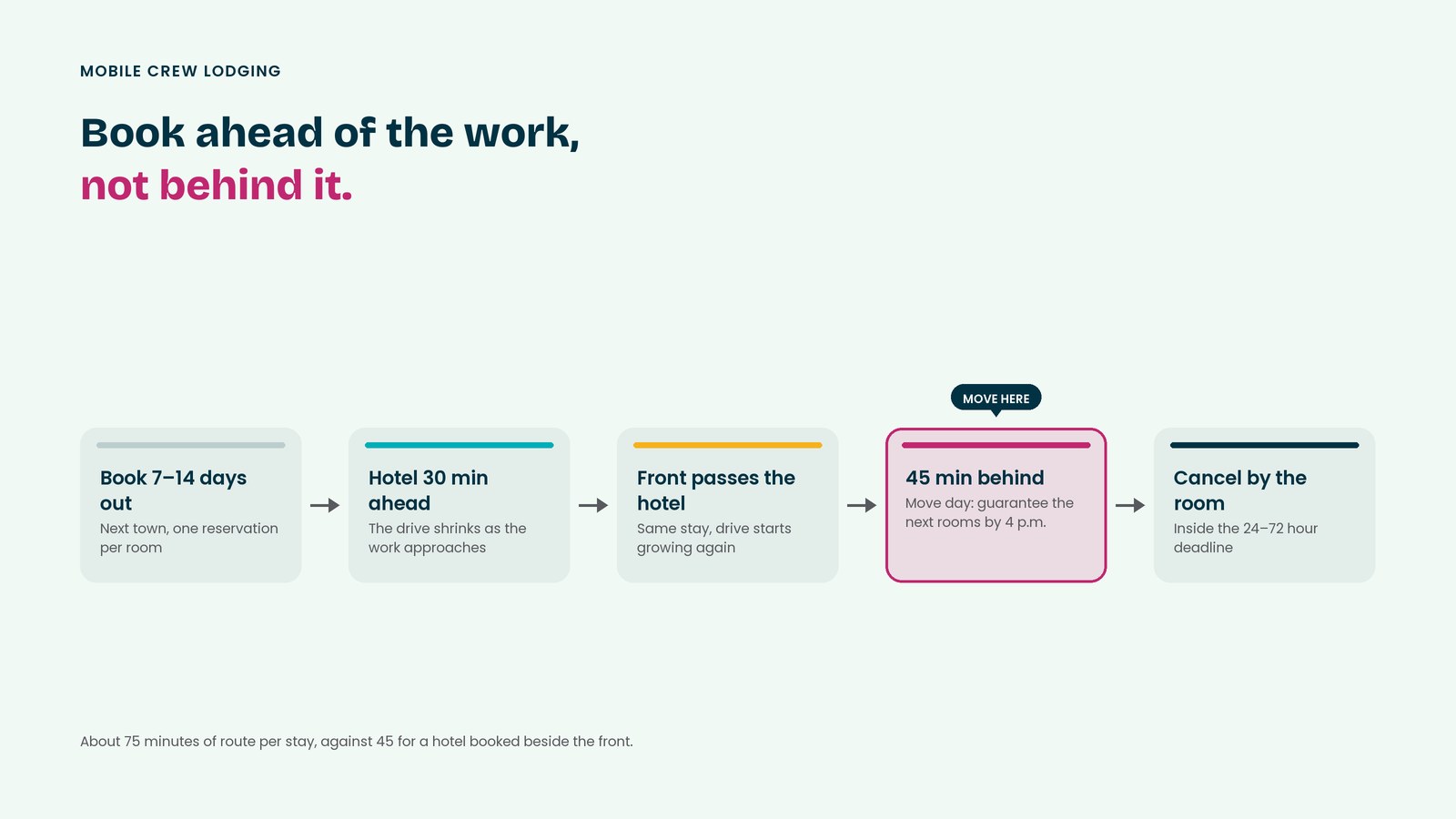
Book it as a chain of short stays that leapfrog the work: put the crew in a hotel ahead of the work front, keep the drive inside 30–45 minutes with an hour as the ceiling, book the next town before the front passes that ceiling, and keep every room on its own cancellable reservation so the dates can slide. One long reservation at one hotel, or the whole route booked up front, is what turns a rain week into a bill.
What is mobile crew lodging?
It is lodging for crews whose job site moves while they work: pipeline spreads, transmission and distribution line crews, fiber and broadband builds, highway and rail maintenance, and storm restoration. A rig crew changes location every few weeks; these crews can change towns every few days. A front that advances 25 miles on rural two-lane road adds roughly half an hour each way to the drive from where it started.
The term covers two different answers. One is a mobile camp — skid-mounted sleepers or RVs hauled along the route, which usually only pays off for large crews in places with no rooms at all. The other, and the usual answer for a crew of 5 to 50 within reach of towns, is a sequence of hotels booked one stretch at a time.
When should a moving crew change hotels?
When tomorrow’s drive would pass the ceiling you set for the job. The working target is 30–45 minutes each way at shift change, with an hour as the hard limit, measured in minutes rather than miles for the reasons in how far from the rig crew lodging should be. On a 12-hour shift, every extra 15 minutes each way is half an hour a day out of sleep.
The leverage is in where you book, not just when. A hotel beside the front on the day the crew moves in only gets farther away, and lasts until the front is 45 minutes past it. A hotel 30 minutes ahead of the front gets closer as the work approaches, then lasts until the front is 45 minutes past it — roughly 75 minutes of route from one stay instead of 45, or about 40% fewer moves. Every move skipped is one less late check-in and one less chance to lose a night.
How far ahead should you book the next town?
Far enough that the rooms still exist, close enough that the dates are known. The window you will see used most often is 7–14 days, tightened as the front gets close. Two things set it.
- Inventory. The next town on a rural route may have two limited-service properties of 40 to 60 rooms. A 20-person crew needs a third or more of one of them, the same week as hunting season, a Friday home game or another contractor’s crew.
- The group line. Many hotels treat 10 or more rooms on the same night as a group and route the request to a sales office, which means a contract, a deposit and an attrition clause — the instrument we argue against in why room blocks are the wrong fit for crew work. Larger crews often split across two properties in the same town.
Cancellation deadlines commonly sit 24 to 72 hours before arrival, so a booking made 10 days out stays free to move for a week while the schedule firms up.
Should you book one long reservation or several short ones?
Short, and one per room. A moving crew’s departure date is a forecast, and hotels price forecasts badly:
- Leave early from a long reservation and many properties charge an early-departure fee, often one night, unless they had 24 hours’ notice.
- Arrive a day late and the first night is a no-show — commonly one night plus tax, and on many hotels’ terms the rest of the reservation is cancelled with it.
- Prepaid, non-refundable rates are typically 10–15% cheaper. One rain week on a 12-room booking erases that several times over.
Book each room separately and a single hand who stays behind to finish a tie-in costs one extension, not a rebooking of the crew. Book the stay to the expected move date and extend by the day if the work stalls — while that hotel still has the nights.
What does moving every week do to hotel tax?
It usually means the crew pays it on every night. In Texas, a room held for 30 consecutive days with no break in payment becomes exempt from the 6% state hotel occupancy tax and the local hotel taxes on top of it (34 TAC §3.161). A crew that changes hotels every 10 days never gets there, so budget the full tax on a mobile job.
The exception is the stretch where the work stalls: a river crossing, a bore under a highway or a substation tie-in can hold a crew in one place for five weeks. When you know that in advance, give the hotel written notice at the start — a confirmed reservation of 30 nights or more counts — and the exemption dates from the first night if the stay runs the full 30 days. Other states set their own thresholds.
What do hotels say no to with a moving crew?
Ask before you book, because the answer varies by property, not by brand:
- Trailers and equipment in the lot. A three-quarter-ton pickup towing a 20-foot trailer takes two or three car spaces, and many limited-service properties ban trailers outright or limit them to a few spaces at the edge of the lot.
- Mud and cleaning. Some properties add a cleaning fee for rooms they judge excessively soiled; ask what the threshold is before 20 sets of boots come through the lobby.
- Breakfast that opens too late. A 6 a.m. breakfast is no use to a crew at the gate at 6. Ask for grab-and-go bags; many properties will set them out early if asked the day before.
How should a move day work?
The crew works a full shift, so the move happens around it:
- Morning: check out of the old hotel before the crew leaves, with bags in the trucks. Checkout is typically 11 a.m. or noon, and an afternoon return to collect bags is commonly billed as a half or full extra night.
- Before the old hotel’s deadline: cancel every night it still holds past the move. Do it room by room so a hand who is staying back keeps their room.
- Before 4 p.m.: make sure every room at the new hotel is guaranteed. A non-guaranteed reservation is commonly released at 4 or 6 p.m., and a crew that comes off shift at 7 and drives an hour reaches the desk after 8 — with the names on the reservations matching the IDs it will show.
Globeo books mobile crews this way, across 30,000+ partnered hotels on live availability, at a negotiated rate plus one flat fee per room night, with no block, no minimums and no volume commitment. Each room can be extended, swapped or cancelled without losing the rest of the reservation; a US-based 24/7 concierge handles the late check-in and the night a desk cannot find the booking; and every town on the route lands on one weekly, cost-coded invoice. More for construction crews and oil and gas crews, and on what a crew lodging service handles after you book.
Common questions
What is mobile crew lodging? Lodging for crews whose job site moves while they work, such as pipeline, power line, fiber and road crews. It is usually a chain of hotels booked a stretch at a time along the route, and occasionally a mobile camp hauled with the job where there are no rooms.
How often should a moving crew change hotels? When the drive would pass the ceiling set for the job — commonly 45 minutes, with an hour as the hard limit. Booking each hotel ahead of the work front, rather than behind it, lets one stay last while the front approaches and again after it passes, so the crew moves roughly 40% less often.
How far in advance should you book hotels for a moving crew? The window most often used is 7–14 days for the next town, kept on reservations that can be cancelled 24–72 hours before arrival. Book earlier for small towns, hunting season or any week another crew is in the area.
Is a group block a good idea for a moving crew? Rarely. A block commits you to dates and a room count, usually with attrition penalties, while a moving crew’s dates change with the weather. Individual reservations can move with the work.
Do moving crews pay hotel occupancy tax? Usually on every night. In Texas the exemption needs 30 consecutive days in the same room, which a crew moving every week or two never reaches; a long stall in one place, notified to the hotel in advance, is the exception.
Talk through this in your operation.
A 30-minute demo, a real person from the concierge desk on the call, and the numbers from your last crew rotation.