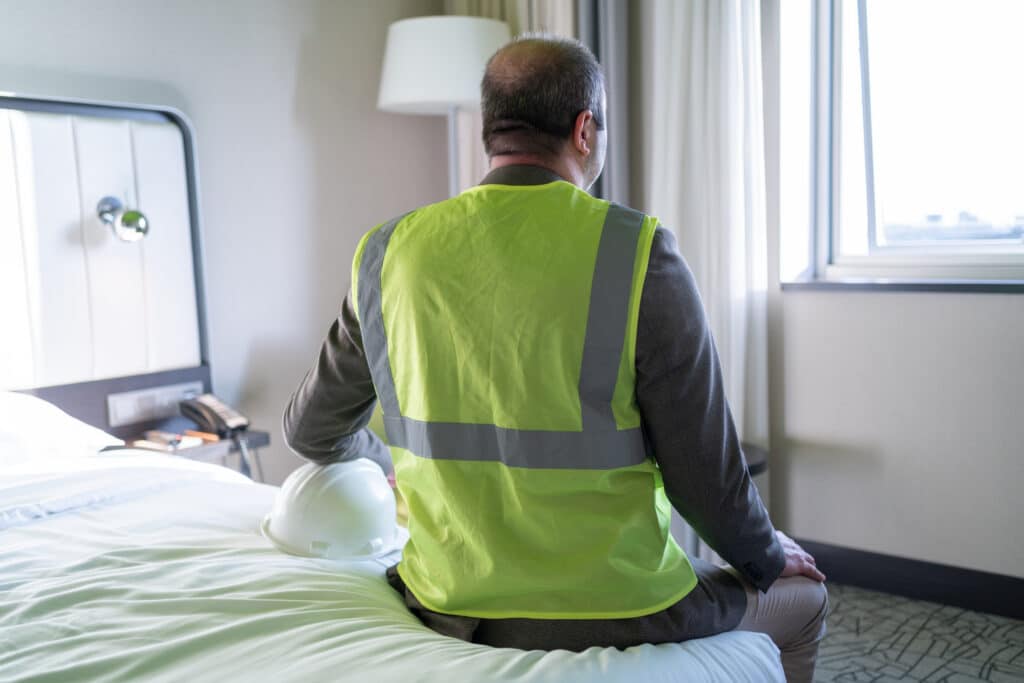
It’s a little after seven in the evening, and a crew member is walking to his truck after a twelve-hour shift. The job wrapped safely. Every box on the safety plan got checked. And now he has a fifty-minute drive, in the dark, tired, to a motel two towns over that may or may not have his room ready when he gets there.
Everything the company controls on site went right. But the part of his day that carries some of the highest risk, the drive when he is most fatigued and the rest he will or won’t get tonight, happens after he clocks out, in a place the company booked but rarely thinks about as a safety decision. That is the blind spot in how a lot of organizations think about crew welfare. Duty of care is treated as something that lives inside the fence line. For a crew that travels, most of the risk lives outside it.
Duty of care doesn’t clock out
Duty of care is the responsibility an employer holds for the safety and wellbeing of its people. On a fixed site, that responsibility is obvious and well managed: training, PPE, procedures, supervision. For a traveling crew, the same obligation follows the worker off the clock, onto the road, and into the room where they are supposed to recover before doing it all again tomorrow.
You cannot send someone hundreds of miles from home to work a demanding schedule and treat where they sleep as a line item disconnected from whether they are safe. The lodging decision is a welfare decision. It is just usually made by whoever had time to call a front desk, on price, without anyone asking whether the choice protects the crew or quietly works against them.
Where a crew sleeps decides how much they sleep
The link between rest and safety is not a soft idea. It is one of the most consistent findings in workplace-safety research, and it is the reason lodging belongs in the same conversation as any other hazard control.
OSHA is direct about it: long shifts, extended hours, and irregular or night schedules raise the risk of fatigue, and fatigue raises the risk of errors, injuries, and accidents. The National Safety Council treats fatigue as a leading workplace-safety factor for exactly the industries that run crews. And studies of construction workers have found that when sleep drops well below what the body needs, injury rates climb sharply, with the most severely under-slept workers seeing markedly higher injury rates than their well-rested peers.
None of that risk shows up in a room rate. But a room that sits an hour from the site, or one so noisy or uncomfortable that nobody sleeps well in it, is a fatigue input just as surely as the shift length is. The difference is that shift length is scheduled and scrutinized, and lodging usually isn’t.
The commute tax
Proximity is the lever most people underrate. A crew housed an hour from the job doesn’t just face a dangerous drive at the two moments they are most tired, the start and end of a long day. They also lose that time out of their rest. Two hours a day on the road is two hours not sleeping, not eating a real meal, not recovering. Over a three-week job, that debt compounds, and it shows up as slower reactions and thinner attention on exactly the days the schedule is tightest.
Cutting the commute is one of the cleanest fatigue-management moves an employer actually controls. You can’t always shorten the shift. You can very often shorten the drive. Housing a crew close to the site protects sleep, reduces the most dangerous miles of their day, and gives back time that goes straight into recovery. It is a safety intervention that happens to also make the crew’s life better.
What a bad room actually costs
There is a people cost that runs right alongside the safety one. To a crew member far from home, the room is part of the job. It is where the assignment either feels respectful or feels like being treated as freight. A long commute after a hard shift, a property in an area that doesn’t feel safe, a front desk with no record of the reservation late at night, none of that gets blamed on the hotel. It gets blamed on the company that sent them there.
And it follows the company. In a labor market where skilled crews have options, whether someone takes the next assignment, refers a friend, or quietly stops answering the phone is shaped by how they were treated on the last one. Lodging is one of the most tangible signals a worker gets about how much the employer values them. Get it consistently right and it barely registers, which is the goal. Get it wrong and it becomes the story the crew tells about you. Turnover is expensive to backfill, and a preventable lodging problem is a strange place to lose good people.
What crew-ready lodging actually looks like
Protecting a crew through lodging is not about luxury. It is about a short, unglamorous list of things being true every time, in every market.
Proximity to the site, so the commute stays short and sleep stays protected. Verified safety and cleanliness, so nobody is spending the night somewhere they feel they have to watch their back. Consistency from one market to the next, so a crew sent to a town the company has never worked doesn’t draw the short straw. Flexibility for the realities of crew work: roster changes, early check-outs, late arrivals, the shift that runs long. And a real person to call at any hour when something goes wrong, because on crew schedules, something eventually does. Those are welfare features. On the road, they are the difference between lodging that supports the crew and lodging that undermines them.
Making duty of care repeatable
The hard part is not knowing what good looks like. It is delivering it every time, in every market, on the schedules crews actually run, without a coordinator having to become an expert in a new town under deadline. That is what a managed lodging program is built to do.
Instead of booking property by property and hoping, a managed program works from a vetted network, places crews near the site, holds a consistent standard across markets, and puts a 24/7 desk behind every stay. It means the crew in an unfamiliar county gets the same reliable, near-site, decent room as the crew in the home market, because the standard travels with the program rather than depending on who made the call. Globeo builds crew lodging around those needs, the truck parking, the roster changes, the odd-hour check-ins, and the human support, which is the same worker-first thinking that has been part of who we are since the beginning.
Duty of care, handled this way, stops being a good intention and becomes a process. The crew is rested because they are close and comfortable. They are safer because they are rested. And they come back, because the company treated the whole assignment, not just the hours on site, as its responsibility.
The bottom line for the people side
Where a crew sleeps is not a back-office detail. It shapes how much they rest, how safely they drive and work, and whether they stay. Treating lodging as a duty-of-care decision, close to the site, safe, consistent, and backed by real support, is one of the highest-leverage things an employer can do for both worker safety and retention. The crew notices. The safety record notices. And so does the turnover number.
Frequently Asked Questions
What is duty of care for traveling crews?
Duty of care is an employer’s responsibility for the safety and wellbeing of its workers, and for a traveling crew that responsibility does not stop at the jobsite gate. It extends to how they get there, where they sleep, and whether the conditions off the clock let them show up rested and safe. Lodging is one of the most direct ways an employer meets, or misses, that obligation.
How does lodging affect worker fatigue and safety?
Where a crew sleeps determines how much they sleep. A room far from the site, or one that is noisy, unsafe, or unreliable, cuts into rest, and safety research consistently links short sleep and long combined hours to higher injury and accident risk. Near-site, quiet, dependable lodging protects the rest that keeps a crew alert on the job.
Does a long commute after a shift increase injury risk?
It adds risk in two ways. The drive itself, done tired at the end of a long shift, is dangerous, and every minute spent commuting is a minute subtracted from sleep. A crew housed an hour from the site loses two hours of rest a day to the road, which compounds fatigue across a multi-week job. Cutting the commute is one of the most practical fatigue-management levers an employer controls.
How does crew lodging quality affect retention?
To a crew member on assignment, the room is part of the job. A long commute, an unsafe area, or a property with no record of the reservation at 11 p.m. rarely gets blamed on the hotel, it gets blamed on the employer, and it shows up in whether the worker takes the next assignment. Consistent, decent lodging is a quiet but real driver of whether crews come back.
What should companies look for in crew lodging for worker wellbeing?
Proximity to the site to protect sleep, verified safety and cleanliness, consistency from market to market so no crew gets a worse deal, flexibility for roster changes and odd check-in times, and a real person to call around the clock when something goes wrong. Those are welfare features, not luxuries.
How does a managed lodging program support duty of care?
A managed program standardizes crew care across every market: a vetted property network, near-site placement, consistent quality, and 24/7 human support, so a crew in a town the company has never worked before gets the same reliable room as one in its home market. It turns duty of care from an intention into a repeatable process.
Courtney Tiedt, Human Resources Manager, Globeo
Globeo builds crew lodging around the people in the rooms: near-site placement, vetted properties, flexibility for the way crews really work, and 24/7 human support. If where your crews sleep has become a safety and retention question, talk to us.