
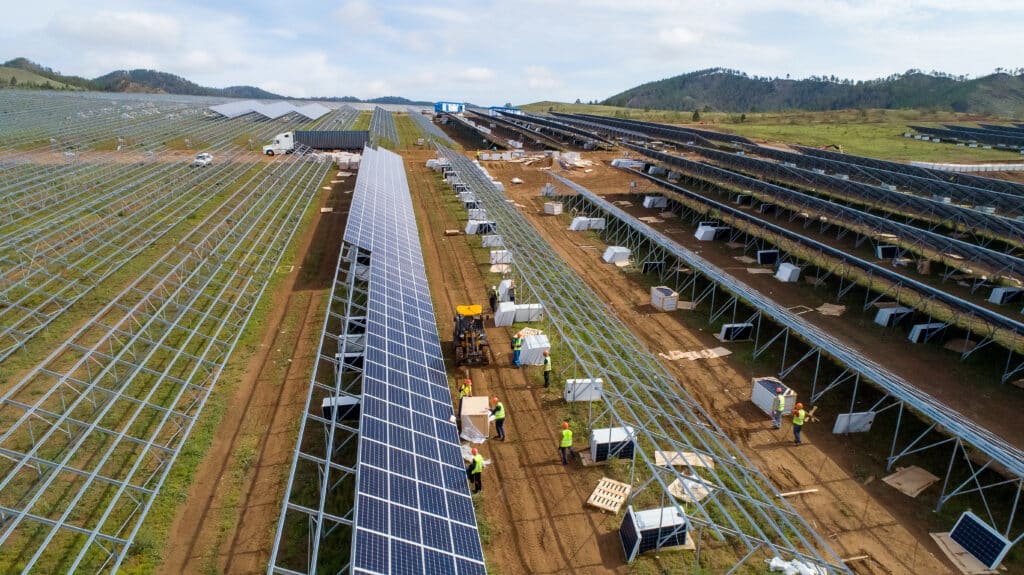
It’s 6:30 in the morning at a job site forty-five miles west of Abilene. The sun hasn’t broken the horizon yet, but the crew buses have already been rolling for ninety minutes. Three hundred construction workers, including civil, electrical, mechanical, racking crews, and panel installers, are inbound to a 500-megawatt solar farm that’s six months into an eighteen-month build. The closest hotel cluster is back in Abilene. The nearest town to the site has one motel with twenty-two rooms, and they all booked out two weeks before the project broke ground.
This is the math of the U.S. renewable energy buildout. It’s quietly becoming one of the most expensive problems on every utility-scale project happening west of the Mississippi.
The boom is real and almost always remote
The Department of Energy projects U.S. utility-scale solar capacity will roughly double between now and 2030. Wind is on a similar trajectory. The Inflation Reduction Act extended the production and investment tax credits that make this math work, and developers have responded. Utility-scale interconnection queues at every major ISO are now multi-year backlogs.
The catch is geographic. Solar farms get sited where land is cheap, irradiance is high, and the substation is close. Wind farms get sited where the wind blows consistently and the land is open. Both criteria push projects into the rural quadrant of the country: West Texas, the Texas Panhandle, southeastern New Mexico, eastern Colorado, the upper Midwest, the high plains of Wyoming and Montana. These are exactly the counties without significant hotel inventory.
A 250-megawatt solar farm needs roughly 300 to 500 workers at peak construction. A 600-megawatt wind farm needs roughly 250 to 400. Project durations run twelve to twenty-four months. The math: a single project will spend somewhere between $1.5 million and $5 million on crew lodging across the build, and that number adds up fast for developers with multiple projects in the same region.
Why direct hotel blocks and Airbnb both break
The first instinct for most construction project managers is to call the local Holiday Inn or Best Western and lock in a block. This works for thirty or fifty rooms in a market with hospitality inventory. It does not work for renewable energy projects.
Direct hotel block contracts fail for renewable energy crews in three specific ways.
First, room counts don’t flex with phased construction. Renewable projects ramp up by trade. Civil first, then racking, then electrical, then commissioning. Each phase requires different crew sizes. A direct block contract locks in a fixed number of rooms, paid for whether they’re occupied or not. When the phase changes and the crew size shifts, the developer is either paying for empty rooms or scrambling to find more.
Second, local inventory caps out fast. A small-town hotel with sixty rooms can’t house three hundred workers. Developers end up blocking rooms across five, eight, sometimes a dozen properties spread across multiple towns, each with its own contract, its own contact, its own billing cycle.
Third, service levels collapse under industrial loads. Three hundred crew members checking in over a Saturday afternoon overwhelms a small property’s front desk, housekeeping cycle, and laundry capacity. Hotels accept the booking and then quietly degrade service, which the project superintendent finds out about when the crew shows up to dirty rooms and no breakfast.
Airbnb solves none of these problems. It introduces its own. Forty individual Airbnb bookings means forty individual reimbursements, forty separate receipts, forty separate cleaning fees, zero service guarantees, and no centralized record of who is staying where. For a developer trying to maintain workforce documentation for IRS prevailing wage compliance, that’s an audit problem waiting to happen.
What a managed crew lodging program actually does
A managed lodging program is a different animal. The developer signs a single contract with one lodging provider. That provider, Globeo in this case, does the regional inventory work. We contract with every hotel, motel, lodge, extended-stay property, and cabin operator within a defined radius of the project. The properties become network inventory.
When crew sizes phase up or down, the program flexes. A 300-room peak in month nine, an 80-room trough in month four, a sudden bump to 350 when a delay compresses three trades into the same window. All of it gets absorbed by the network instead of fought over with individual property managers.
Billing consolidates to one invoice per project, broken out by phase, by trade, or by cost center as the developer needs. Compliance documentation is centralized. One record of every crew member’s stays, one place for the auditor to look. Service guarantees become enforceable because the lodging provider has volume leverage with the properties in the network.
This is how renewable energy lodging is being solved at the category level, and it’s a fundamentally different model than the project-by-project hotel-block-and-Airbnb scramble most developers are still running.
The shift is happening because the projects keep getting bigger
A 50-megawatt project from a decade ago could be staffed and housed by improvising. A 500-megawatt project today, or the 1-gigawatt projects being permitted now, cannot. The cost of managing crew lodging at industrial scale, on the schedules renewable projects actually run, has crossed the threshold where ad-hoc solutions cost more than dedicated lodging programs.
The developers handling this well share three traits.
They centralize lodging procurement at the program level, not the project level. One provider relationship across the portfolio, not separate scrambles per project.
They include lodging logistics in the project plan from financial close, not after groundbreaking, which means the lodging provider is contracting inventory while the EPC contract is still in negotiation.
They treat lodging as a workforce-retention input, not a cost line. Two hours of daily commute on a crew bus costs the project more in productivity than the rate differential between a budget hotel and a quality one.
Where this goes next
The U.S. is going to build more utility-scale renewable energy capacity over the next decade than in the entire history of the grid. That buildout is going to land in rural counties that have never seen industrial workforce volumes at this scale. The lodging problem is structural and it is not going away.
The first developers to solve it cleanly will carry that advantage across every project they break ground on for the next ten years. The ones still scrambling per project will keep paying for it in delayed schedules, crew turnover, and EPC change orders.
Frequently Asked Questions
Where do solar farm and wind project workers stay during construction?
Most utility-scale renewable energy projects are built in remote locations chosen for land availability and resource quality, not for hotel inventory. Globeo provides managed crew lodging programs that aggregate hotel rooms across regional markets, contract directly with properties for project-length stays, and handle centralized billing, so developers can house entire crews without scrambling for rooms one project at a time.
Why don’t traditional hotels and Airbnb work for renewable energy crews?
Direct hotel block contracts lock developers into fixed room counts that don’t flex with phased crew ramp-up, and Airbnb-style fragmented bookings create billing chaos and no service guarantees. Globeo’s lodging programs are built around how renewable projects actually staff up, with predictable crew sizes, unpredictable schedules, multi-month durations, and contracts that scale with the build phase.
How do developers manage crew lodging at scale across multiple renewable projects?
Centralized program management. Globeo gives developers one operations contact, one billing channel, and one reporting layer across every project in their portfolio. This replaces the per-project hotel-block-and-Airbnb scramble most developers currently rely on. It’s how renewable energy lodging is being solved at the category level as the energy transition scales.
— Brady George, VP of Sales, Globeo
Globeo manages workforce lodging programs for utility-scale renewable energy developers across the United States. If you’re planning a solar or wind buildout in a market that doesn’t have the hotel inventory you need, talk to us.

